

Contractor Insight 48
A Car Has a Service History. A House Has Nothing.
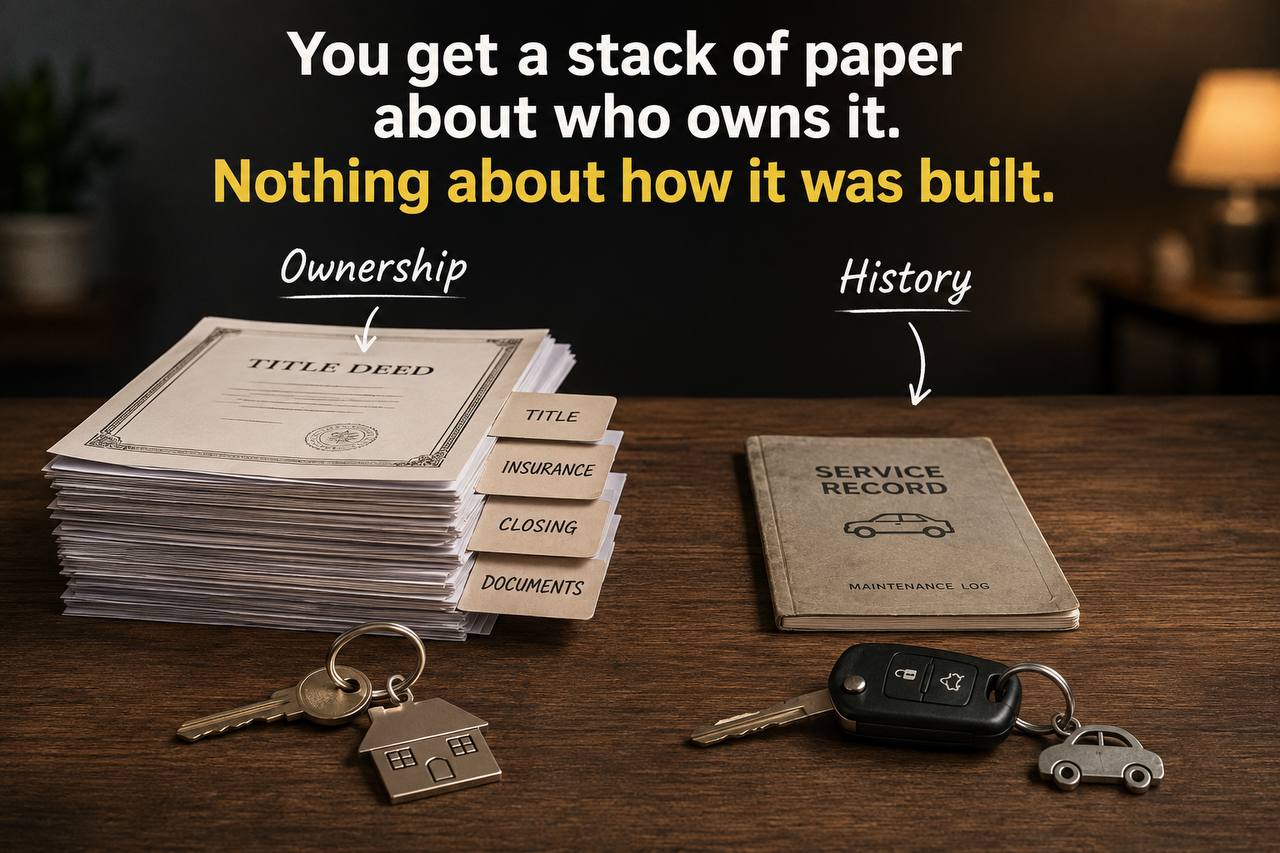
When you buy a used car, you can find out almost everything about it. When you buy a house that will outlast any car, you can find out almost nothing.
The history is tied to the VIN and travels with the car from owner to owner. Nothing is tied to the house.
A House Nobody Built in One Piece
We were called in to renovate an ordinary residential house. Two floors, two bathrooms, everything looked normal.
It turned out it hadn’t become a house all at once. In the fifties, one recreation room was built here. Then the owner changed and added another room. Then the owner changed again — and added on again.
By the time we arrived, it was a full house. Assembled by three different people across three different decades.
The job was straightforward: replace a few beams in the basement.
We opened it up — and there was no foundation. The house was sitting on sand and cinder block.
We asked the owner for documents. He didn’t have any. We asked the township — they didn’t have any either.
The owner knew almost nothing about the house. He bought walls.
Replacing beams turned into reinforcing the structure. Work planned for two months took more than six. And we had to start not with the foundation, but with drawings — because no drawings existed.
The house stood for seventy years. The information about how it was built didn’t outlive a single owner.
Why It Works for a Car
A car’s service history rests on three things.
The object has a permanent identifier. Everyone who works on it leaves a record. The record stays with the object, not with the shop.
A house only has the first one. The address is permanent and never changes — it’s more reliable than a VIN. But nobody keeps records against it, and whatever the contractor learned drives off with him.
Why This Still Hasn’t Been Done
With a car it’s simpler: the history is unambiguously good for the owner, because it makes the car worth more.
With a house it’s the opposite. A permit for an addition or a serious renovation goes into the assessment. The house goes up in value — the property tax goes up with it. And the owner pays that every year, not once at the sale.
So part of the work gets done without documents deliberately. Not out of ignorance, not because of rushing, but because here the paperwork costs money annually.
That’s exactly how houses like the one above come to exist: three additions, not one document, and an owner who doesn’t know himself what’s under his floor.
And the township records only what was filed — and far from everything gets filed.
The Only One Who Saw It
Every house has people who saw it from the inside — literally. They opened the walls, they know what’s under the floor, they found out what isn’t in the documents.
Each of them found it out from scratch. Each of them took what he learned with him.
We spent six months understanding a house that at least three people before us had already understood.
A 1998 car has a history. A 1950 house doesn’t. Not because it’s technically harder.
The address isn’t going anywhere. In StarProve, a Site Log stays tied to it — what one contractor found out doesn’t have to be found out again by the next one.
Disclaimer: StarProve app is a private, closed platform for verified contractors to preserve and access professional project experiences and operational history. StarProve app does not identify, rate, or profile homeowners, residents, or property owners. The platform does not provide consumer reports, credit scores, or background checks on individuals, and is not a consumer reporting agency under the FCRA. All Job Site Logs reflect the independent professional experiences and opinions of the contractors who submit them.