

Contractor Insight 43
How a Past Project Shapes the Next Contract
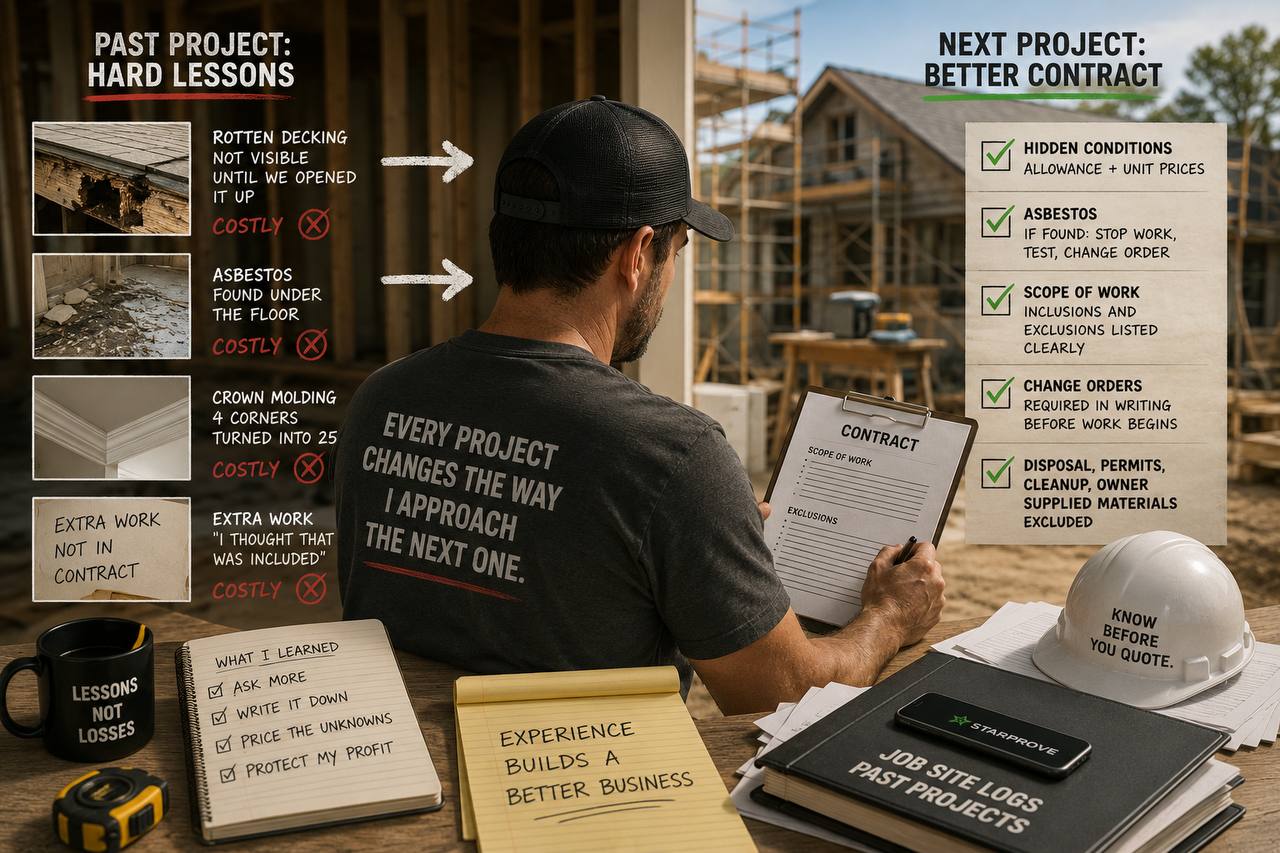
Almost every clause in a good construction contract didn’t end up there by accident.
Payment terms, change orders, exclusions, timelines, responsibility for owner-supplied materials, hidden damage — very often, behind each of these clauses stands a project where the contractor once ran into a problem.
After a payment dispute, the payment schedule changes.
After unpaid extra work, a rule appears: no extras without a written change order.
After opening a wall with unexpected damage, hidden conditions get added to the contract.
After a client’s “I thought that was included in the price,” the contractor starts spelling out scope and exclusions in far more detail.
It turns out that the experience of one project effectively writes the contract for the next.
“I thought that was included”
This is one of the most expensive phrases in remodeling.
In a discussion among general contractors, one builder asked his colleagues which “I thought that was included” case turned out to be the most expensive for them.
The answers varied widely.
One contractor described asbestos discovered only after demolition began. Now his contract states separately that if asbestos is found, additional work and payment will be required.
Another recalled a crown molding estimate where, after work started, it turned out it wasn’t about four corners, but twenty-five.
Someone named rotten roof sheathing. You can’t know in advance how many sheets will have to be replaced until the old roof is off. So the contractor now sets the price for replacing a single sheet ahead of time.
These are different jobs, but the result is the same: the project ended, and the experience gained on it stayed in the next proposal or contract.
A Clear Scope is The Starting Point
This is exactly why a clear scope isn’t just a description of the work. It’s the reference point against which you can determine what counts as additional work. How small requests turn into a different project is a separate topic.
It’s important to spell out in detail not only what’s included, but what’s not included in the price: permits, disposal, owner-supplied materials, cleanup, hidden damage, and other potentially disputed work.
Change Orders Cost Real Money
The problem is far bigger than a few unpleasant conversations with the client.
According to 2026 research from Dodge Construction Network and Clearstory, 98% of general contractors have experienced fee erosion because of change order negotiations. Nearly half of those contractors said the loss exceeded 10% of their fee on at least some projects. And 93% have experienced delayed project closeout because of change order issues.
That’s why a good contract isn’t a document written once and forgotten.
It evolves along with the contractor’s experience.
But There’s One Problem
One contractor ran into asbestos and changed his contract.
Another lost money on extra work and started requiring a written change order.
A third learned to set a unit price for unknown quantities ahead of time.
Each one gained a useful lesson.
But usually that lesson stays only with him.
The next contractor comes onto a different project and starts gathering the same experience from scratch — sometimes paying for it with his own money.
Every project changes how a contractor approaches the next one.
The question is whether that experience has to start from zero every time.
This is exactly why the history of completed work has value not only after a project ends. It can be useful before the next estimate, before the next contract, and before the next decision about a job.
Disclaimer: StarProve app is a private, closed platform for verified contractors to preserve and access professional project experiences and operational history. StarProve app does not identify, rate, or profile homeowners, residents, or property owners. The platform does not provide consumer reports, credit scores, or background checks on individuals, and is not a consumer reporting agency under the FCRA. All Job Site Logs reflect the independent professional experiences and opinions of the contractors who submit them.