

Contractor Insight 41
Before You Agree to Finish Another Contractor’s Job: What to Check at Handover
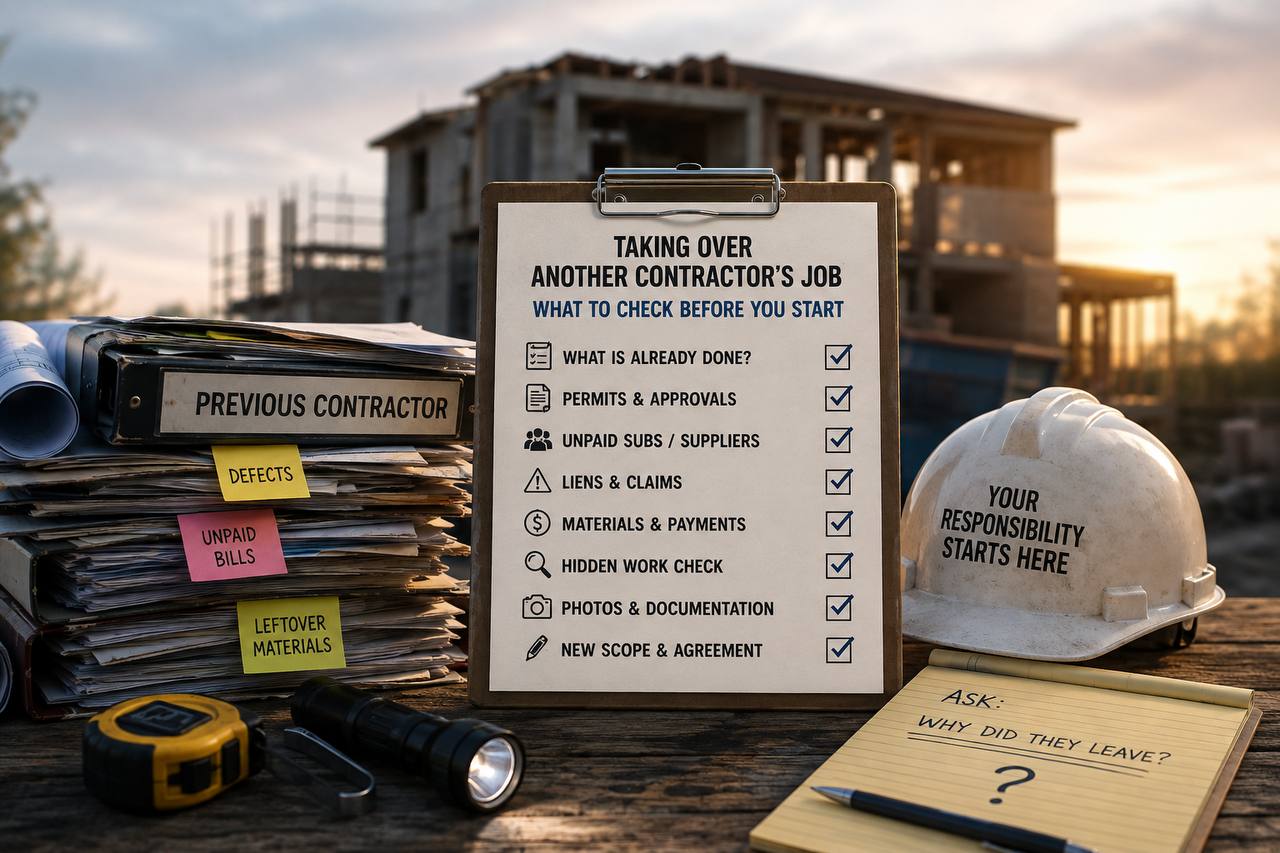
You get called out for a regular estimate. The client says nothing about what came before you. And you arrive — and see the work is already started. Someone was here before you, and they left.
And from that moment, everything changes. If you take it on, you take not just the remaining work — you take everything that was done before you. An unfinished bathroom isn’t just an unfinished bathroom. It’s a project that already has a history — technical, financial, and contractual. And part of that history can become your problem.
First, Find Out What You’re Actually Taking On
Before you pick up a tool, figure out what you’re stepping into:
• What’s already done, and what’s left.
• Whether permits were pulled — and for whose phase.
• Whether there are unpaid subcontractors or suppliers.
• Whether there are liens or payment disputes on this property.
• What materials have already been paid for, and what haven’t.
• What already-completed work you now become responsible for.
The last two points are the most dangerous. The old contractor may have left unpaid materials or hold a claim on the property. You don’t see it with your eyes, but you’re walking into someone else’s financial conflict without even knowing it.
Check The Hidden Work
Check what’s already done physically, not on the client’s word. Level, square, hidden connections.
Back in 2008, in the Journal of Light Construction, contractor David Barrows described how he came in to continue a basement remodel after a fired predecessor — and found that the already-assembled structure was out of square. He only found it because he checked himself. What looks finished can be crooked at its core.
Check especially what will soon be closed up by finish work: waterproofing, structural prep, rough-in. That’s where someone else’s defects hide — the ones you’ll answer for later. If the previous work is bad, sometimes you have to open it up and redo it.
Photograph Everything Before You Start
Document the existing condition before you pick up a tool. Photos of the whole site, notes, a punch list of already-completed and defective work — before you begin.
The reason is simple: once you start working, the line between “his defect” and “yours” can no longer be drawn. Old problems will get pinned on you, because you’re the one who worked here last. Photos of “as received” aren’t an archive — they’re your protection.
Write a New Scope, Don’t Continue The Old One
You can’t just continue someone else’s scope. You need a new, separate one: what exactly you’re taking on, materials, timeline, price, payment terms. In the contract, separate your zone of responsibility from theirs — what you answer for, and what the previous contractor and their warranty answer for. Without this, the whole project is yours by default.
What The Documents Won’t Tell You
The documents give you part of the history. Permits show what was filed. Contracts and liens show who owes whom. Photos show the state of the work.
But there’s a question they won’t answer: why did the previous contractor leave?
Was he fired? Did he walk? Was he not paid? Was there a conflict over scope? Did an inspection fail? The homeowner will tell his version. But the previous contractor knows a completely different part of this property’s history — what he found behind the wall, how the client behaved, why he really drove off.
That knowledge exists. It just left with him when he drove off the site.
The unfinished work is visible. The history behind it often isn’t.
Disclaimer: StarProve app is a private, closed platform for verified contractors to preserve and access professional project experiences and operational history. StarProve app does not identify, rate, or profile homeowners, residents, or property owners. The platform does not provide consumer reports, credit scores, or background checks on individuals, and is not a consumer reporting agency under the FCRA. All Job Site Logs reflect the independent professional experiences and opinions of the contractors who submit them.