

Contractor Insight 31
The Industry Learned to Keep Its Own Experience. It Never Asked About Anyone Else’s
...There is an entire field of research on how construction loses knowledge. It’s called knowledge loss, and it has been studied for decades.
The logic is always the same. A company finishes a project. The lessons need to be captured. They need to reach the next team. That’s what post-project reviews, knowledge bases, and BIM data capture were built for.
And even that doesn’t work. The Project Management Institute puts it plainly: lessons get identified, get documented — and then get lost in a database, so companies repeat the same mistakes on the next job.
Researchers at Purdue University who surveyed U.S. construction companies list the reasons. The fragmented, project-based nature of the industry. Workload and time constraints. Legal issues. Lack of trust. And a low perceived value in doing this work at all.
What every one of those solutions assumes
They all assume one thing: the next person on that site is one of yours.
Your colleague. Your second crew. You, two years from now. Knowledge moves inside the company, through internal channels, between people who know each other.
In commercial construction, that holds. A general contractor runs a site for years, the team turns over slowly, and there is one database for everyone.
In residential, the next one is a stranger
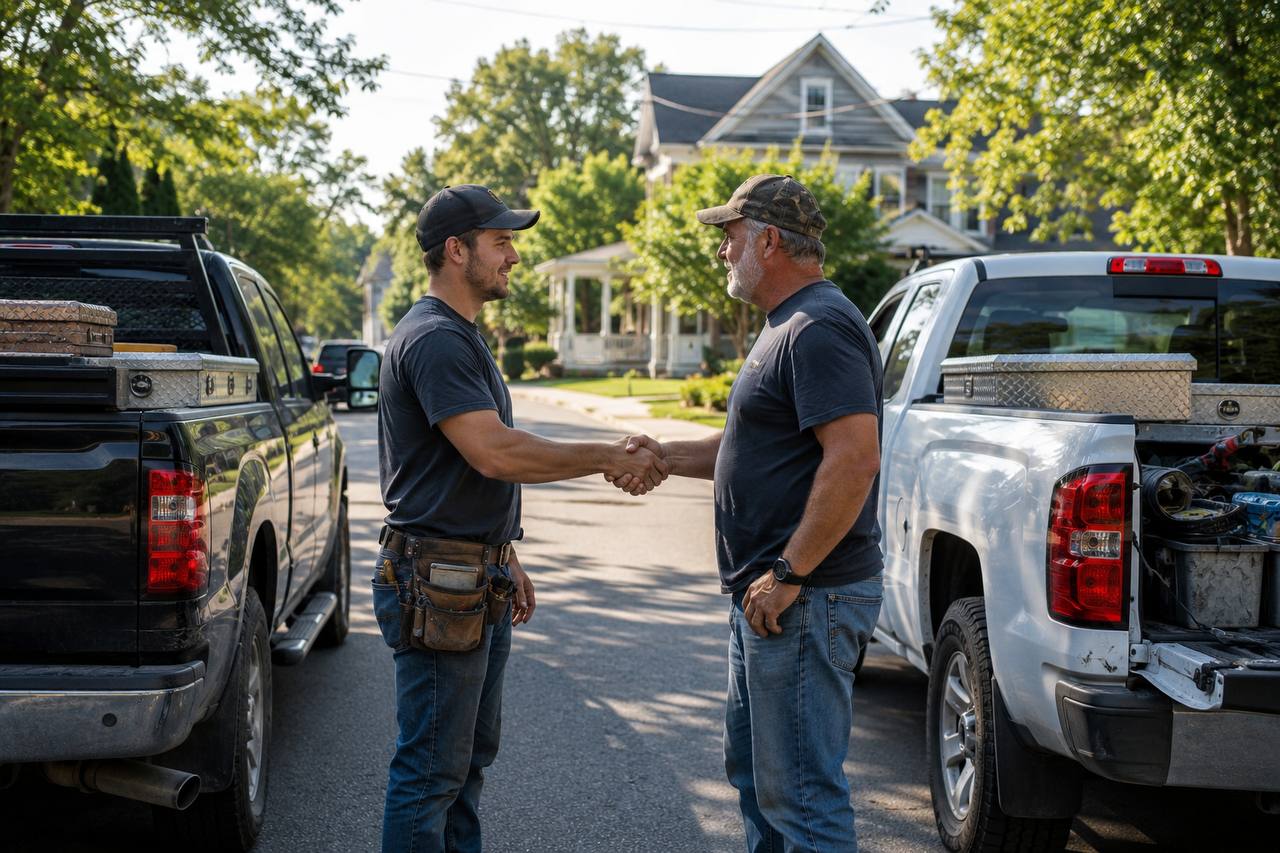
You finished the kitchen and drove off. Eight months later another contractor pulls into that driveway. He isn’t from your company. He isn’t from your town. You have never met and you never will.
You share no database. No project. Nothing.
Your experience doesn’t get lost in a database — there is no database to put it in.
Why this was never solved
The answer is in that same research, among the reasons: legal issues and lack of trust.
Inside a company, those barriers are barely noticeable. Between companies, they become a wall.
Sharing what you learned about a client is legal exposure. Trusting a stranger’s note about a property you’ve never seen is a question of who wrote it.
So no tool appeared. Not because nobody thought of it. Because the approach looked impassable.
We ran into this ourselves
Working across different job sites, we kept hitting the same thing. The experience was there. There was nowhere to put it.
We’re competitors. That’s true, and nobody is trying to change it. But competing is about the work — not about what’s behind a wall in a house two streets over. Passing that along isn’t weakness. It’s necessary.
StarProve didn’t come together in three seconds. It took months of working through how to make shared experience useful, and safe for the person leaving it. So that a contractor leaving what he learned knows he’s among his own, in a closed room.
Both of the decisions below came out of that question.
What changes it
Both barriers come down if two things change.
First: the unit of record is the address, not the person. You log what was true about the property, not an opinion about who lives there. The legal exposure leaves with the personal judgment.
Second: access by verified license only. Records come from working contractors who passed verification, not from anonymous accounts.
The industry spent decades on the question of how not to forget what I know. That’s a fair question.
It just doesn’t answer the one waiting for you on Monday morning, when you pull up to a house you’ve never seen.
You didn’t forget your own experience. You don’t have anyone else’s.
Sources:
Project Management Institute — Lessons (Really) Learned? How To Retain Project Knowledge And Avoid Recurring Nightmares
Australasian Journal of Construction Economics and Building — Gathering and Disseminating Lessons Learned in Construction Companies to Support Knowledge Management
Disclaimer: StarProve app is a private, closed platform for verified contractors to preserve and access professional project experiences and operational history. StarProve app does not identify, rate, or profile homeowners, residents, or property owners. The platform does not provide consumer reports, credit scores, or background checks on individuals, and is not a consumer reporting agency under the FCRA. All Job Site Logs reflect the independent professional experiences and opinions of the contractors who submit them.